
A Personalised Website and AI Voice Message for Every Donor
How Muslim Charity gave all 40,000 donors their own personalised giving website and an AI voice message during Ramadan 2026, achieving a 75% higher average donation per email open.
Introduction
Ramadan is the period when most Muslim charities raise the bulk of their annual income, and it is also when donor inboxes are at their most crowded. Every organisation is sending out emails, sometimes multiple times a day, and they begin to blur into one. The challenge is no longer simply reaching donors - it is giving them a reason to feel that a message was meant for them.
Our work with Muslim Charity had already proven what personalisation could do. In a previous Ramadan campaign with Giving Analytics, AI-written emails built around each donor’s own giving history dramatically outperformed standard templates, and the project went on to win National Fundraising Awards. That award-winning project is documented in our earlier case study, AI-Powered Email Personalisation. With that success behind them, Muslim Charity wanted to take things to the next level.
For Ramadan 2026 the ambition was larger. Rather than a personalised email alone, Muslim Charity wanted to give every one of its roughly 40,000 donors something they had never received from a charity before: their own dedicated website summarising their giving and its impact, and a personalised voice message recorded in a real colleague’s voice. All of it was generated from a single CSV export of their legacy CRM.
The Challenge
A saturated Ramadan inbox
During Ramadan, donors receive a constant stream of appeals from many charities at once. Standard messages, however well intentioned, struggle to stand out. To earn attention and a donation, a communication has to feel genuinely relevant to the person receiving it, not like one more broadcast.
A small charity with a legacy CRM and no data team
Muslim Charity is a registered charity with around £7.5 million in annual income and roughly 25 staff. It has no in-house data team and runs on a legacy CRM with limited segmentation capabilities. Any solution had to work from a simple data export rather than expensive new systems or specialist staff.
Personalisation stuck at the first name
For most charities, personalisation still means inserting a donor’s first name at the top of an otherwise identical message. That is not personalisation in any meaningful sense, and donors see straight through it. The goal was to reflect each donor’s real relationship with the charity, in their own words and figures, across an entire experience rather than a single greeting.
The Solution
Giving Analytics built a pipeline that turned one CRM export into a complete, individualised experience for every donor: a personalisation engine, a personalised audio message and a personalised mini-site, all generated automatically and all working from the same underlying data.
A personalisation engine
At the centre of the campaign is an engine that derives around 20 signals for each donor from their giving history.
The engine is designed to always surface each donor’s most positive and relevant facts, so that every person sees a reason to feel proud of what they have already done. A large language model then writes a totally personalised message for each donor, trained to match the brand voice of the charity. We implemented many safeguards and tests to make sure that none of the numbers or claims were invented.
A personalised audio message
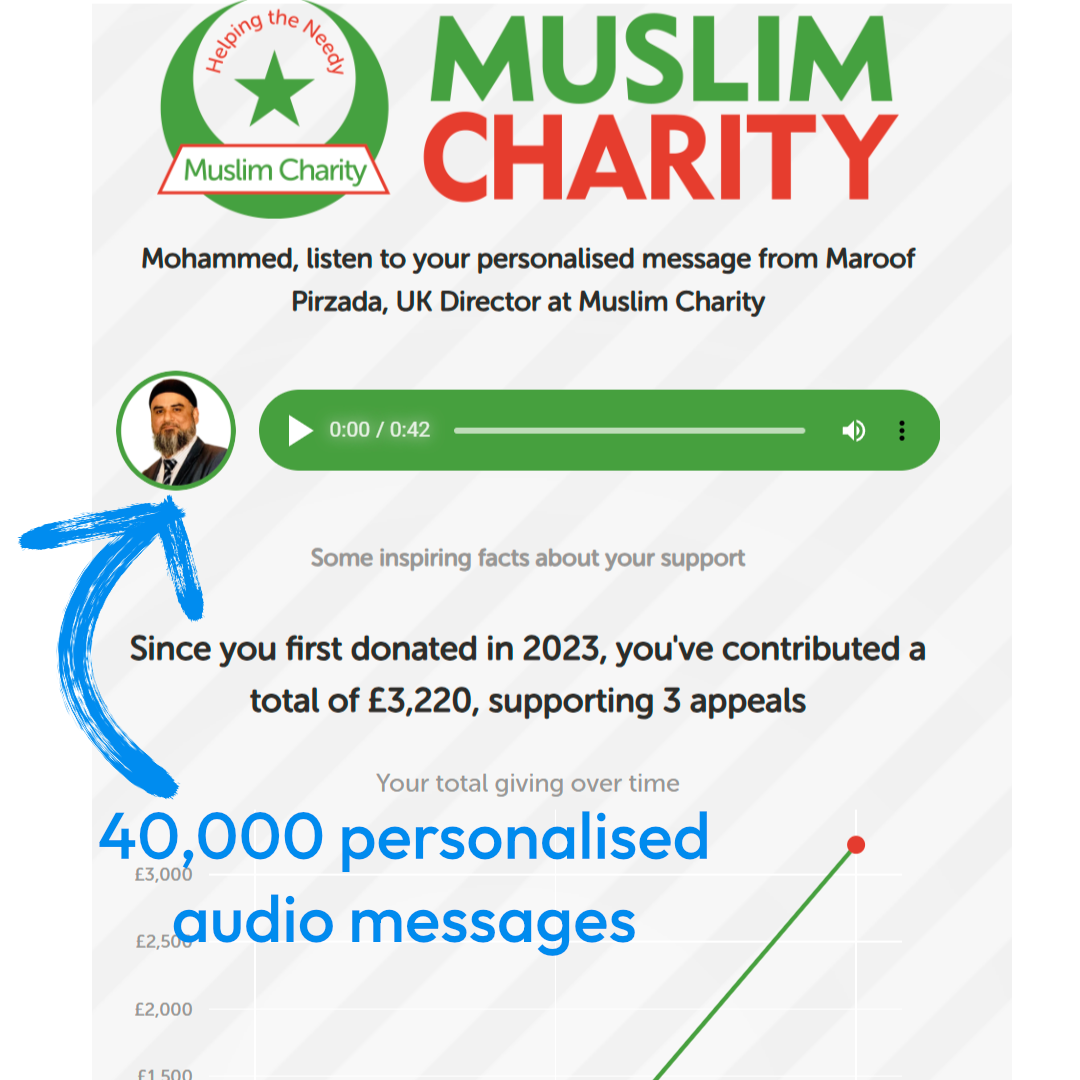
The most striking element is the audio. Each donor receives a short voice message that greets them by name and highlights what they personally have achieved through their giving. The voice is an AI clone of a real Muslim Charity colleague, matched to the donor’s profile: the UK Director, Maroof Pirzada, for most donors, a Scottish colleague (in his very Scottish accent!) for donors in Scotland, and a female colleague for women.
The clip below is an example message produced for a donor, in Maroof’s cloned voice.

A 42 second personalised voice message for an example donor, in the AI-cloned voice of Maroof Pirzada, UK Director at Muslim Charity.
A personalised mini-site
Alongside the audio, every donor receives a link to their own dedicated mini-site: a small website that exists only for them and tells the story of their giving and its impact. No two pages are alike.
Each site brings together four adapting elements:
🎙️ AI voice message - greets the donor by name, highlights their personal achievements, and uses a voice matched to their profile.
📈 Their giving journey - visualisations of how their donations have built up over time and across the different appeals they have supported.
🗺️ Regional context - a map showing the collective impact of their community, placing each donor’s contribution within their city or region.
❤️ Tailored impact story - an impact story tied to the causes they have supported most, so the outcome they read about reflects the work they actually funded.
Everything on the page, the text, the charts, the audio and the messaging, adapts automatically to each donor’s history. There is no template being lightly edited. The same pipeline generated a genuinely distinct experience for all 40,000 donors in the campaign.
The screenshots below show the mobile experience for an example donor.
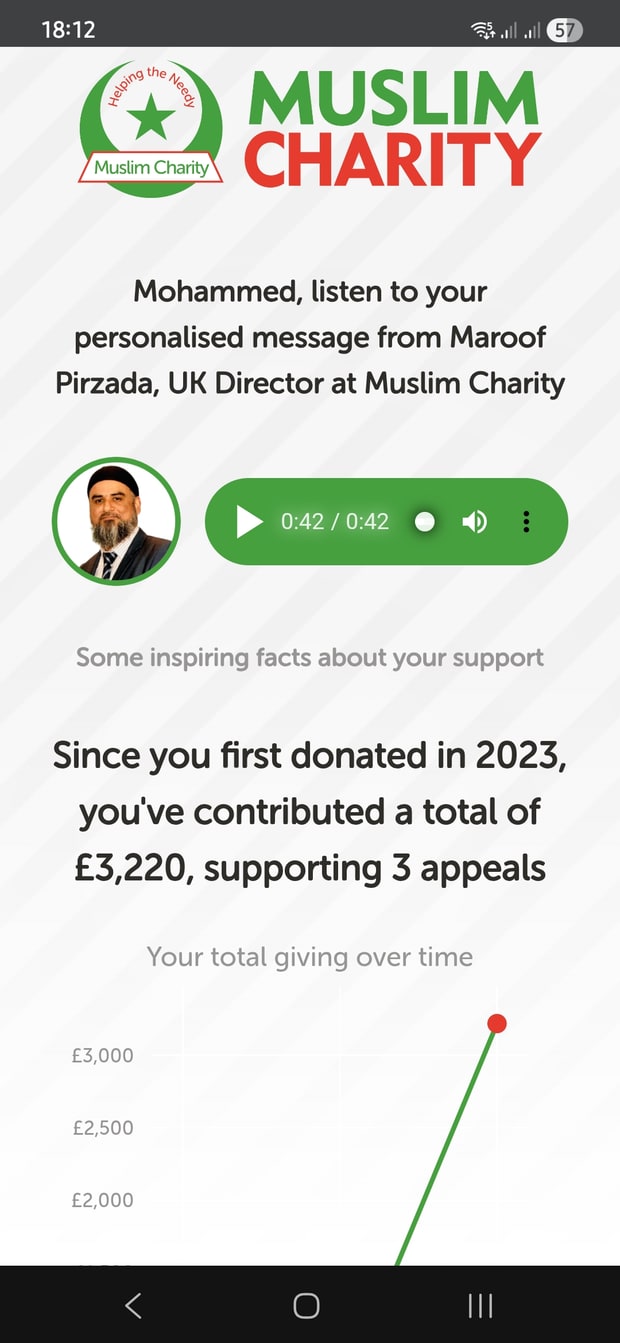
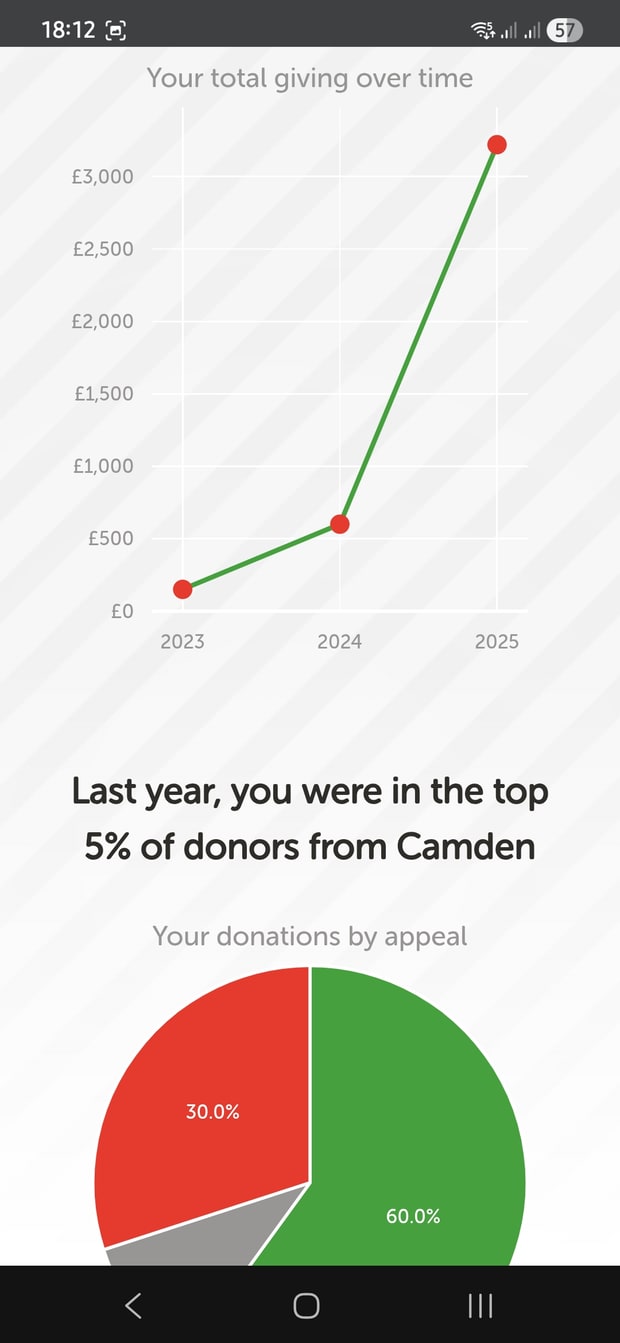
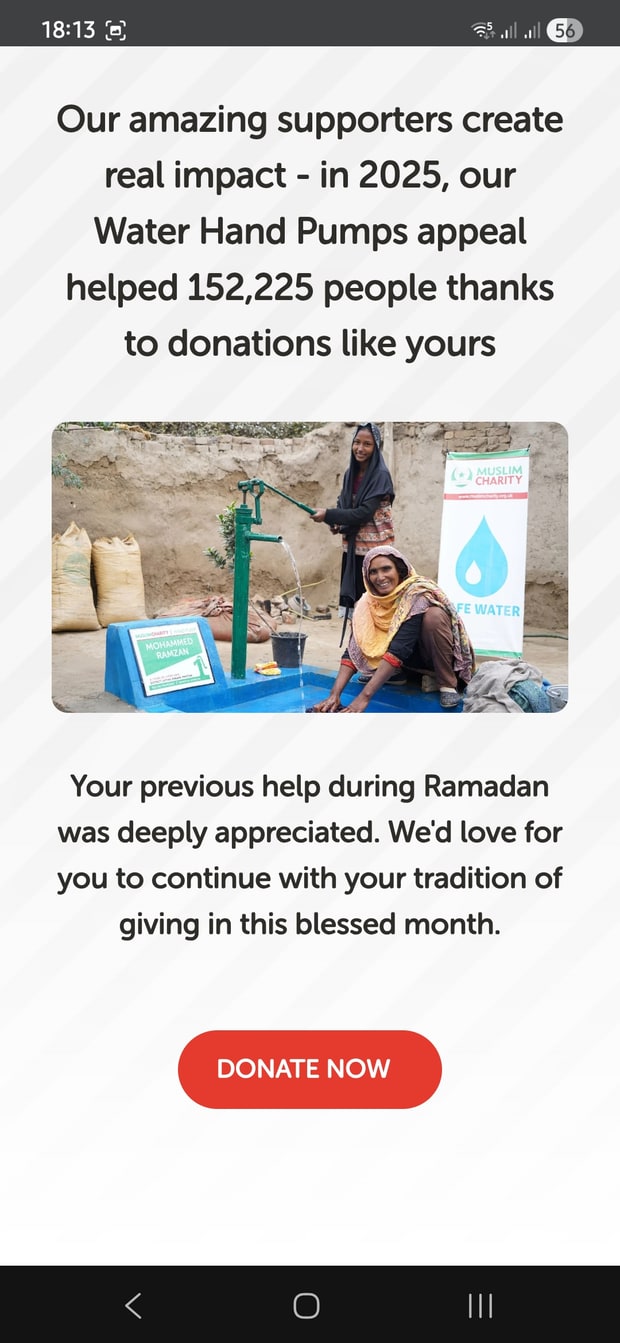
The mobile mini-site for an example donor: the personalised greeting and audio message, the giving-over-time chart with regional ranking, and the tailored impact story with a donate call to action.
Built for accuracy and privacy
Giving figures and impact claims are sensitive, and getting them wrong would do real damage to donor trust. Accuracy and privacy were therefore built into the campaign from the start.
Every fact shown to a donor is pre-verified before any copy is written. The language model writes only around these confirmed numbers, so it cannot invent or exaggerate a total, a ranking or a beneficiary count. Privacy safeguards ensure that comparisons are only ever shown in a way that protects each donor’s identity.
The audio adds a further layer of care. Greetings blend Arabic and English naturally, so a donor hears a warm “Assalamu-alaikum” followed by an English message, in a way that feels authentic rather than bolted on. Together these choices made the experience feel both personal and trustworthy, which is exactly the combination that persuades people to give.
Results
The personalised email that carried this experience achieved a 75% higher average donation per open than standard emails sent in the same period. It was the highest donation per open of any email Muslim Charity sent during that period.
Several factors stood out:
- The content was overwhelmingly about the donor and their impact, rather than about the charity asking for money.
- Donors replied with unprompted thank-you messages, something appeals rarely generate.
- Some donors phoned the charity directly after receiving their site, simply to reconnect.
- A number donated again immediately, and others reconnected with past projects they had supported.
Rather than competing on the volume of appeals during the busiest period of the year, Muslim Charity stood out by making each donor feel genuinely recognised.
Key Learnings
- Personal recognition beats volume. During the most crowded fundraising period of the year, the message that won was the one that made each donor feel seen, not the one that shouted loudest.
- Let the model write, but only around verified facts. Using a language model for tone and language while locking every number to pre-verified data gave the warmth of human writing without the risk of invented claims.
- You do not need a data team or new systems. The entire campaign ran from a single CSV export of a legacy CRM, putting this level of personalisation within reach of small charities.
Conclusion
This campaign shows that a small charity, working from nothing more than a spreadsheet, can give tens of thousands of donors an experience that most large organisations have never attempted: a personal website and a personal voice message, accurate to each donor and respectful of their privacy, produced entirely at scale.
For ambitious charities, the lesson is that the constraint is rarely the size of the team or the age of the CRM. It is whether the data is used to genuinely recognise the person behind each donation. When it is, donors notice, and they respond.
Transform your donor communications
Ready to give your donors something they have never experienced before? Learn more about our personalised communications service or get in touch to discuss your campaign.
On this page